 Allison Biesboer
Summary
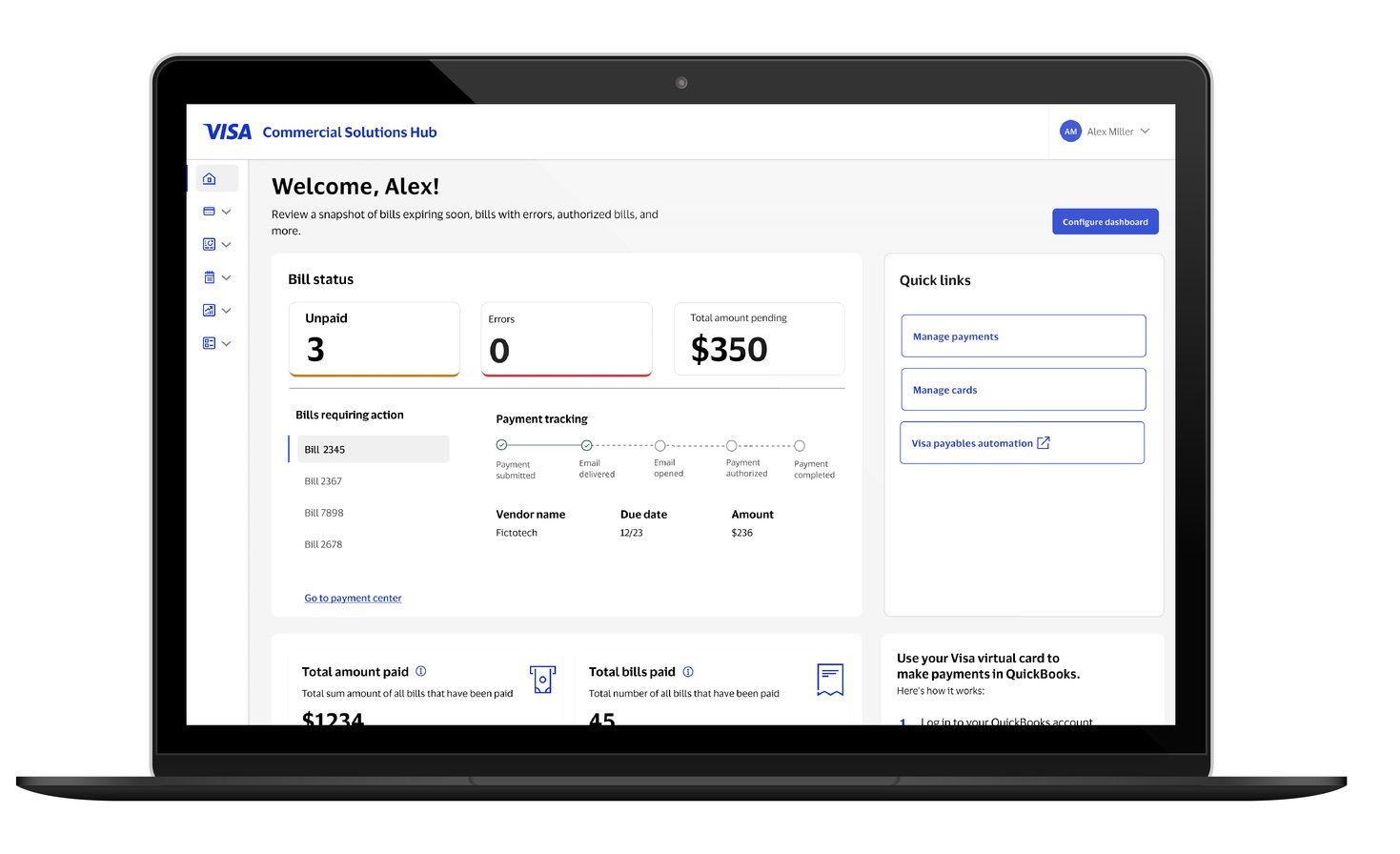
The Visa Commercial Solutions Hub is a new commercial payments ecosystem for financial institutions, fintechs, and business users from mid to large-size companies in Visa’s Commercial and Money Movement Solutions (CMS) portfolio. It provides a range of commercial payment solutions to empower users to streamline their payments, manage their working capital, and boost efficiency. It also offers an array of integrations and additional capabilities and services.
The integrated platform is a personalized and consistent experience for users to easily navigate and accomplish crucial payment tasks. With a single sign-on structure, efficient onboarding process, and a menu of services to choose from, users can expect a faster, more efficient self-service experience than what was previously available at Visa and in the industry.
Prior to the general availability of this platform, users were accessing individual Visa products in a piecemeal capacity, which is less efficient for banks, business users, and for Visa. The core product in the roadmap started with B2B Payables (formerly Visa Payables Automation), and continues with over 25 products and services that plug into an array of existing Visa platforms, all on a scalable, headless architecture. The platform also features several instances of agentic and generative AI capabilities which can better surface business intelligence to bank admins, generate data visualizations for a range of users, and offer an enhanced support experience. As the Content Design and Strategy Lead on this platform, I managed an array of projects and supported over 20 designers in the portfolio. In other words, this platform is massive.
User needs & pain points
Issuer and business user needs and pain points:
- The system did not recognize existing clients, creating inefficiencies in the onboarding process.
- Customers had multiple entry points (URLs) to access each product.
- Customers had difficulties navigating between the different platforms and systems, causing tasks to take longer with higher learning curves.
- Customers experienced complexity in implementation across disparate products.
- Customers experienced confusing content and naming conventions.
- Customers found an inconsistent UI experience across products.
- The overlapping and duplicate product capabilities across similar products were costly for customers.
Visa pain points
Visa offers an expansive set of commercial products and platforms, but they are hard to sell and implement:
- Visa experienced a higher cost associated with supporting, maintaining, and developing each separate system and platform.
- The long lead time to onboard customers delayed time to revenue.
- Technology teams work inefficiently by supporting duplicative product functionality, integration services, and currency/language internationalization.
- The Visa sales team must select the “best fit” for customers at the time of sale, which is not scalable, especially because it’s so hard for them to purchase additional products.
Our goals
Our goals were captured by our yearly-created and quarterly-updated Objectives and Key Results (OKRs). Here’s an example:
Deliver purpose-driven VCS Designs that contribute to the sustainable net revenue growth for the user-centered commercial experiences across mid-size to large market segments.
All our VCS Hub work streams fell under this Objective with a range of Key Results tailored to the content work I led and supported.
- OKRs
The team
Our team included a multidisciplinary group of 7 to 10 product designers at any given time, help from 2-3 design engineering partners (front end developers), 10+ back-end engineering teams spread across the world (located in the United States, Poland, and India), an entire product management organization (too many product managers to count), 2 content designers, 1 accessibility specialist, and a team of 5-6 design researchers. For context, some of our technical engineering teams had upwards of 70 engineers. The multidisciplinary team supported the entire Commercial and Money Movement Solutions portfolio. I began working on this team in October of 2023.
Payments re-imagined for the modern world.
Contribution
Content design leadership and strategy
As the content design lead on this portfolio, I set the content design strategy across the portfolio’s product experiences, with VCS Hub as our highest priority. I supported over 20 product designers, along with one other content designer. Our product content design team was lean, but we ruthlessly prioritized using a design support model we devised (embedded, review, or consultation). We performed an array of duties, including leading strategic projects that aligned to: the information architecture (IA), the AI and agentic strategy, AI-assisted contextual help, terminology, language internationalization, standards, quality assurance, the authoring of product content, writing error and alert messages, and more. We authored and maintained a centralized strategy, which we shared often with partners to enable them. I also managed relationships with product managers and technology partners to ensure cross-functional alignment as the project grew in complexity.
- strategy
- content operations
- planning
- stakeholder management
- cross-functional alignment
Information Architecture
The content team was responsible for establishing and maintaining the navigation schema and sitemap. We unified the Visa Commercial Solutions Hub through a navigational layout designed to set the platform up for scalability. The team originally built a horizontal navigation, and we quickly realized it wouldn’t scale. We performed some research and adjusted our strategy to allow for growth, using a mixed navigation that relied heavily on the vertical navigation.
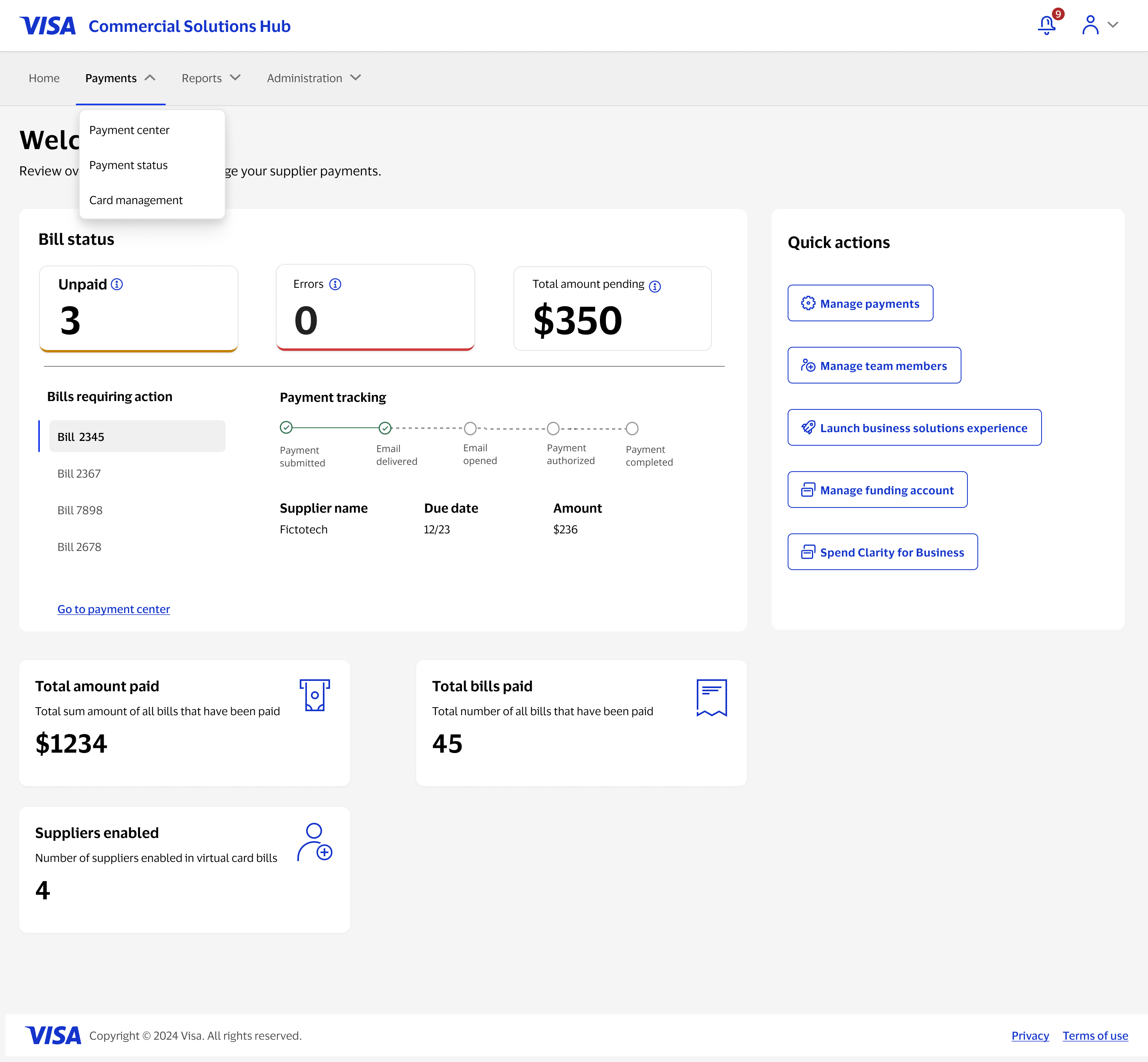
Based on prior research and competitive analysis, we set six principles for naming pages in the navigation:
- Concise
- Noun-based
- Descriptive
- Specific
- Unique
- Persistent
When research challenged a principle, we adjusted. For example, our standard was to avoid repeating “payment” inside the Payments category, but users preferred “Payment status” over “Status” for the added context, so we kept it.
This work stream was challenging because it involved every product manager and technology team. We had to continually align our design to our labeling strategy and organize all the pages within the Hub to optimize for findability. We also needed to understand how the experience was customized for each user role, and we performed tests with design research to validate our choices. We used our taxonomic abilities and knowledge of ontology to help us make decisions. Yet, the main challenge was a very human one—change management. We had to continuously challenge the mental models that existed on our team and sometimes introduce new and unfamiliar terms and organizational structures. It was mental gymnastics!
- information architecture
- taxonomy & terminology
- UX & product design
- cross-functional alignment
Agentic strategy
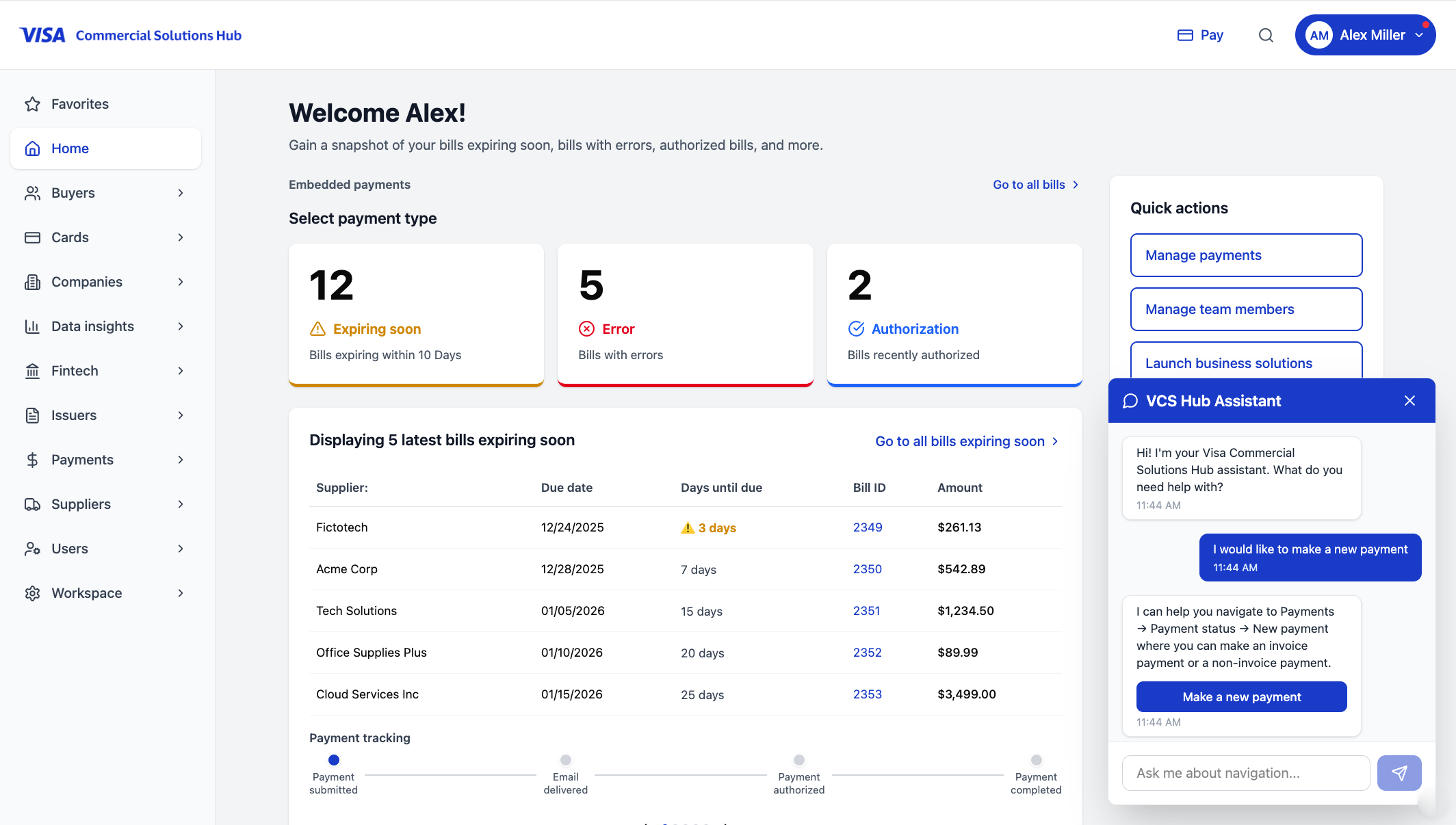
I led the agentic strategy in partnership with a few designers on VCS Hub. Content design as a discipline is increasingly important to the practice of AI, since LLMs are content and text-based, and the subdiscipline of conversational design is increasingly setting up content designers with “main character energy.” The agentic system we architected was designed to have a variety of agents that performed different tasks, acting in tandem to serve the user in their final decision making. This included things like onboarding, where an agent would automatically fill out what used to be manual and time-consuming forms, as well as facilitating payments, contextual help, travel, and more. Content design specifically aided with formatting different intents and entities, creating system prompts to guide different chat patterns and formats, and more. We added a layer of quality and user-specificity to a probabilistic conversational system.
AI-powered help assistance was also part of this strategy. Visa Assist is a product within the consumer portfolio at Visa: an AI-assisted chat experience accessed through the Visa Access portal that helps users connect to documentation and answer Visa-related questions. It had not been leveraged as an integrated chat within a large Visa platform or product; users could only access it separately. I identified the need to partner with the Visa Assist team and build a use case for our platform where the chat interface could be directly embedded for easy access to contextual help. In its simplest form, it could provide how-to tutorials from documentation data, provide definitions, or help point users to where they needed to go. We envisioned a second phase where it could also retrieve the custom data contained within our platform, serving more sophisticated contextual help and assistance use cases, like fetching important payment data, proactively helping a user make a payment, or recommending how a user manages money via forecasting and predictive models. Eventually, it could have grown in sophistication to generate rich media content, such as tutorial videos, to help users with their tasks. I led a successful workshop with several Vice Presidents and our respective teams to plan for this collaboration.

Visa Assistant experience
Click through the two contextual help pathways: a corporate user getting step-by-step guidance in the New payment flow, and an issuer admin pulling payment data through chat. A pulsing purple ring shows where to click next.
Open the prototype- conversational design
- AI strategy
- agentic systems
- chat interfaces
- AI prototyping
- strategy
- workshop facilitation
Components and patterns task force
In order to ensure consistency and quality standards across our platform, we needed more cohesion across what we were building—with 7 to 10 designers at any given time, every designer had their own approach. Our design system could at times be too flexible, and thus not customized enough for our particular commercial use case. Design flows from different designers came out looking different, with variations in spacing, layout, placement, and more. From this issue, the components and patterns task force was born! I established this group using my background on the Visa Product Design System. A core group of our Hub designer leads worked together to build and align on standards developed with the Visa Product Design System as a base. From there, we established unique patterns and customizations that built off of the out-of-the-box components. For example, we created our own bespoke version of tables with our own filtering, search, and data requirements in mind.
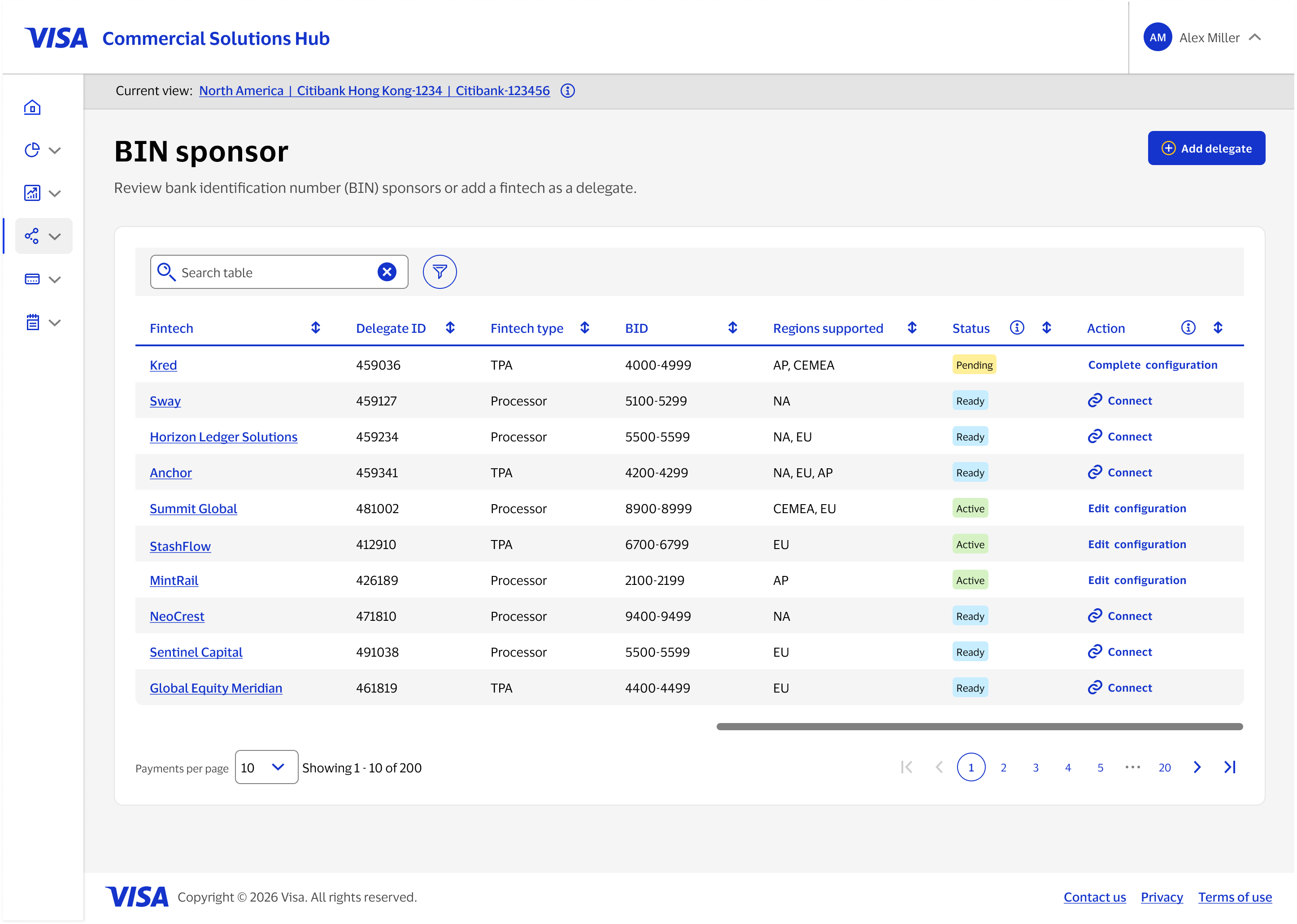
We were a governance body for scaling our design process—we made decisions, down to the pixel, on what our Hub should look like and how it should behave! And we kept a decision log to ensure we could remember and call back to what we agreed on.
Customized standards we developed included:
- Agentic AI strategy
- Banner message standards
- Button size and placement
- Conversational design guidelines
- Custom landing page standards for different users
- Dialogs message standards
- Empty states
- Filter guidelines
- Flag message standards
- Fonts and Type
- Forms
- Footer
- Grid and spacing
- Iconography
- Loading patterns
- Microinteractions and motion
- Navigation (content lead)
- Notifications strategy
- Page templates
- Panels
- Reports
- Responsive layout
- Section message standards
- Status and badges
- Stepper patterns
- Tables
- Tabs
- Toggles
- Tooltips
- Redlines
- White label and cobranding
- design systems
- content design systems
- documentation
- critique
- collaboration
Terminology
The content design team maintained a terminology document for when we introduced new terms in the Hub. Both users and internal team members might have been unfamiliar with new terms, as we designed our content with more human language in lieu of robotic or overly technical language. This was created as an artifact of alignment and change management. We also established a governance process for introducing new terms across the UI layer, the back-end layer, and the API layer that banks used to integrate our data. This helped align our design, product, and tech partners and showcased how we introduced new terms into the Hub. It also demonstrated how we used tooltips and descriptions to help nurture users to understand the changes.
| Before | After and definition | Why |
|---|---|---|
| Proxy pool | Account groupA group of single-use accounts connected to a company’s funding account | Plain language that’s less technical and easier to translate |
| Lodged account | Multi-use accountAn account linked to a supplier profile that can be used for multiple payments | Plain language that’s less technical and easier to translate |
| Payment center | Payment statusThe page where users check on their payment status and create new ones | “Payment center” wasn’t descriptive enough |
| Vendor (in tables) | SupplierA business that accepts Visa commercial cards as payment for the goods and services it provides to other businesses | One consistent term where space is limited |
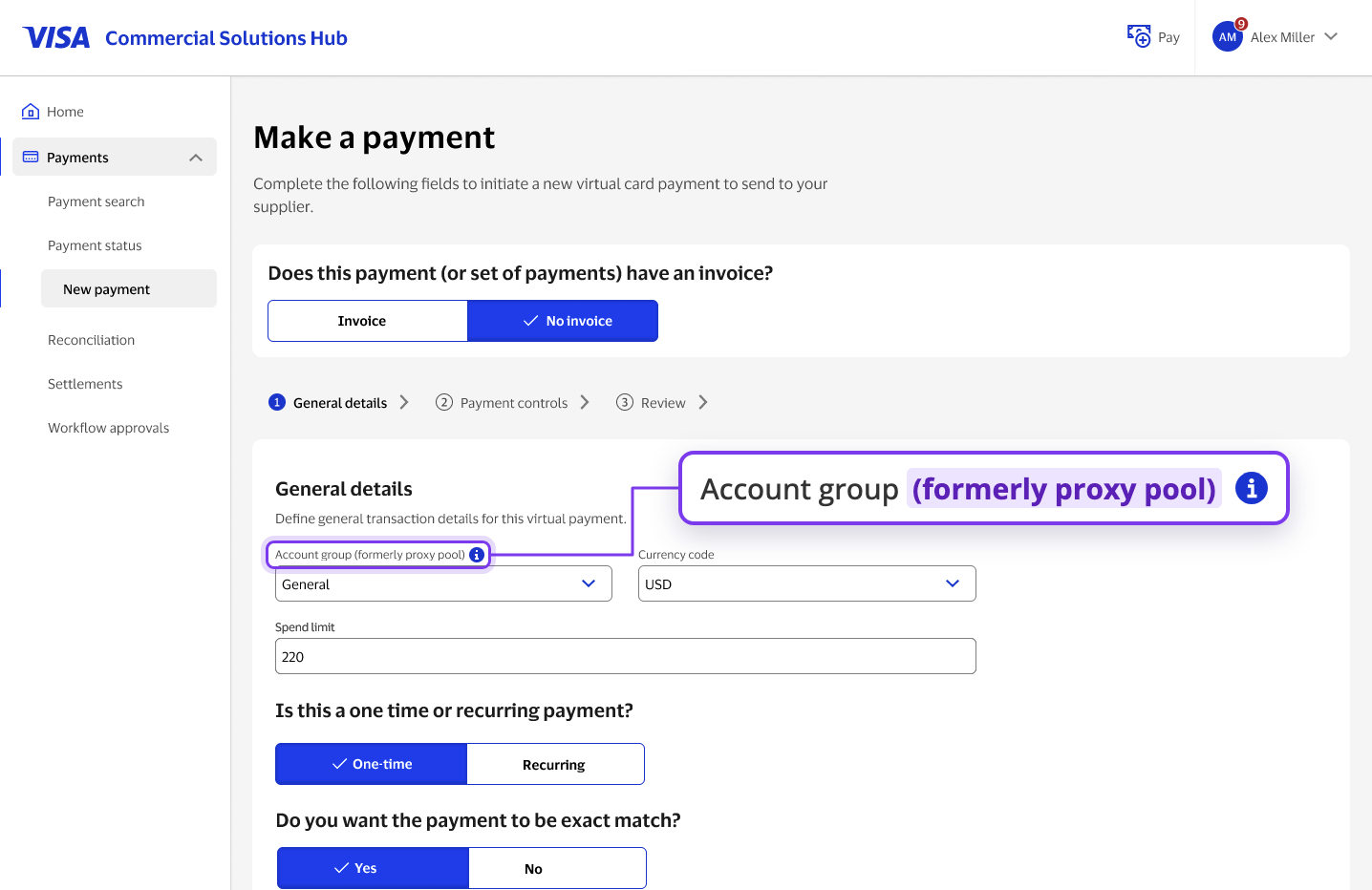
Testing terms with users: We surveyed 77 people at medium and large US businesses. They struggled to define the difference between bill and invoice, or supplier and vendor, but used the terms accurately in context. So we kept both pairs and focused on giving each term enough context.
Terminology governance
Design and product owners met monthly to keep terms consistent across four layers
- Hub UI
- Legacy UI
- Back end
- API
What we asked about every change
- Do other layers need updating?
- Will clients need to change code?
- Does our documentation need to change?
- Do we need release notes, changelogs, or customer communications?
We also maintained a terminology database where we defined over 500 terms in our portfolio, including those that were crucial to our releases. This helped the entire portfolio align on terminology, which in my experience sounds easy but is in reality ridiculously challenging when you work at an enterprise scale designing a massive payments platform.
- taxonomy & terminology
- storytelling
- UX writing
- documentation
- cross-functional alignment
Impact
The Visa Commercial Solutions Hub reached general availability at the end of 2025. It represents Visa’s commitment to democratizing access to commercial payment technology, serving it to customers as a unified solution. According to this GA announcement, at launch, these included:
- AI-Powered Payables: Automate accounts payable with GenAI-driven workflows that anticipate business needs, optimize cash flow and reduce manual bottlenecks.
- Embedded Payments: Integrate payment capabilities into business applications—accounting, ERP or custom workflows—using Visa’s open APIs and intelligent orchestration.
- Reporting and Insights: Harness advanced analytics and GenAI to surface actionable insights, predict trends and empower smarter business decisions in real time.
- Personalized Experiences: User experiences can be tailored by AI, delivering recommendations, alerts and next steps that drive growth and efficiency.
Content and navigation outcomes for users
Our content and navigation work addressed the pain points we started with:
- One place to work: Users navigate one platform with a single sign-on, where they once had a separate entry point for each product.
- Navigation built to grow: Moving to a mixed, mainly vertical navigation lets the Hub scale while maintaining findability.
- Findability by role: Pages are organized and labeled for findability, with the experience customized for each user role and choices validated through design research.
- Plainer language: More human language replaces overly technical terms, and tooltips and descriptions guide users through what changed.
- Consistent terms: A governance process across the UI, back-end, and API layers, along with a database of over 500 defined terms, helps the same term mean the same thing wherever users encounter it and prepares the platform for AI-powered contextual help, so users can get answers and help immediately.
- Help in the moment: Agentic contextual help is designed to let users complete tasks and ask for help right where they’re working, while reducing support ticket close times from weeks to hours.